
Classifier types
Choose the right way to describe the evidence you want to review for a role.
A classifier asks for one useful piece of evidence from an application. Give it a clear label, explain what to look for, and add follow-up questions only where an applicant can usefully add context.
Score
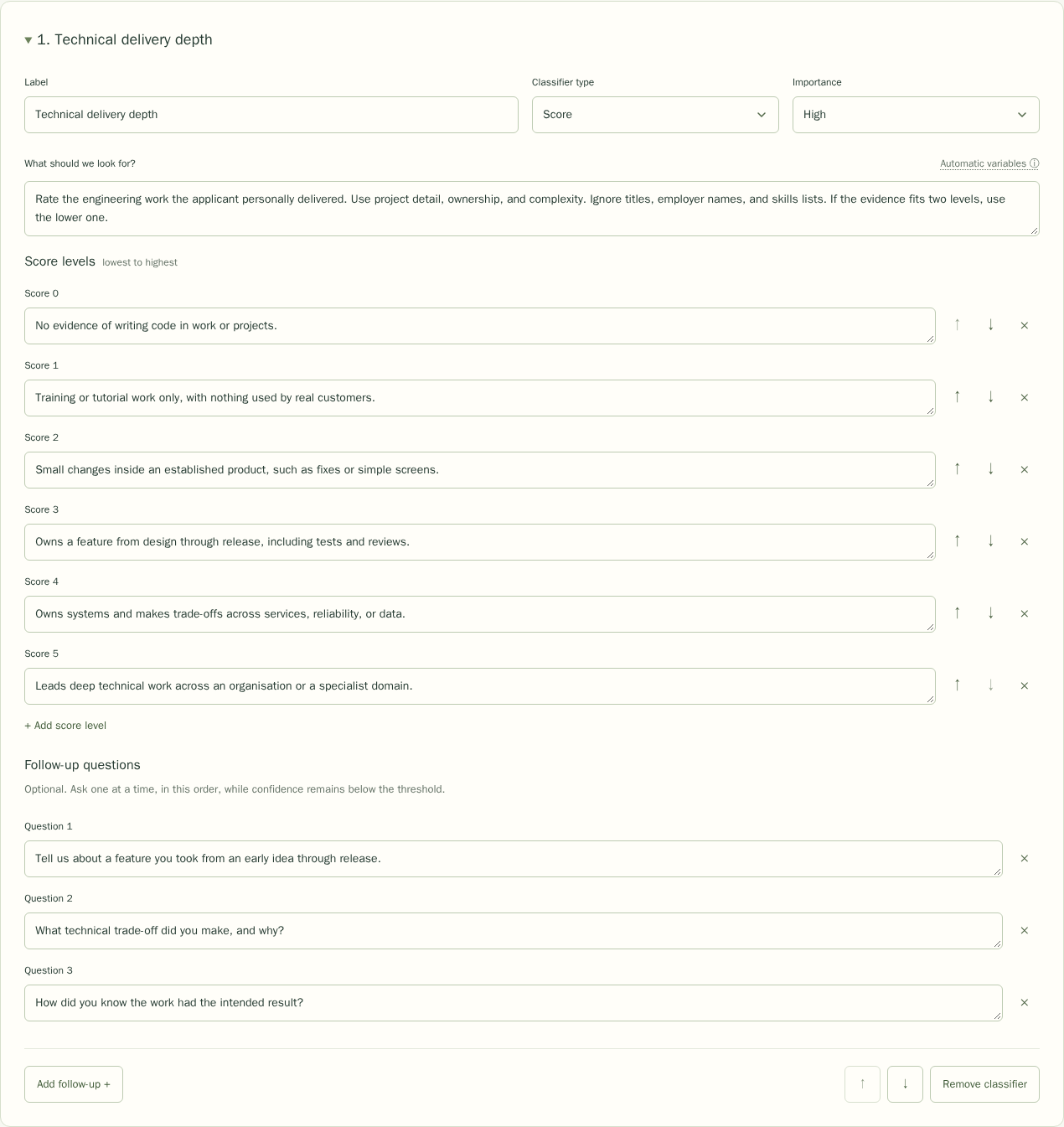
Use Score when evidence sits on an ordered scale. For example, an experience classifier can ask, "How many years of paid engineering experience does this applicant have as of today?" Its levels might be "No paid experience", "1-2 years", "3-4 years", "5-6 years", "7-9 years", and "10+ years".
Add at least two score levels and describe them from lowest to highest. The descriptions matter. They give reviewers a shared meaning for each point on the scale. Keep the scale about one subject. A technical-depth classifier, for example, can move from no evidence of writing code, through small work in an existing product, to end-to-end feature ownership, system-level trade-offs, and deep specialist work. Judge the work described, not job titles, company names, or a list of keywords.
Automatic variables
Use the fixed word today when a classifier needs the current date. Acqoria
detects that word and supplies the current UTC date when it assesses the
application. That means a question such as "How many years of paid engineering
experience does this applicant have as of today?" stays current without an
edit to the job.
today is the only automatic variable currently supported.
Choice
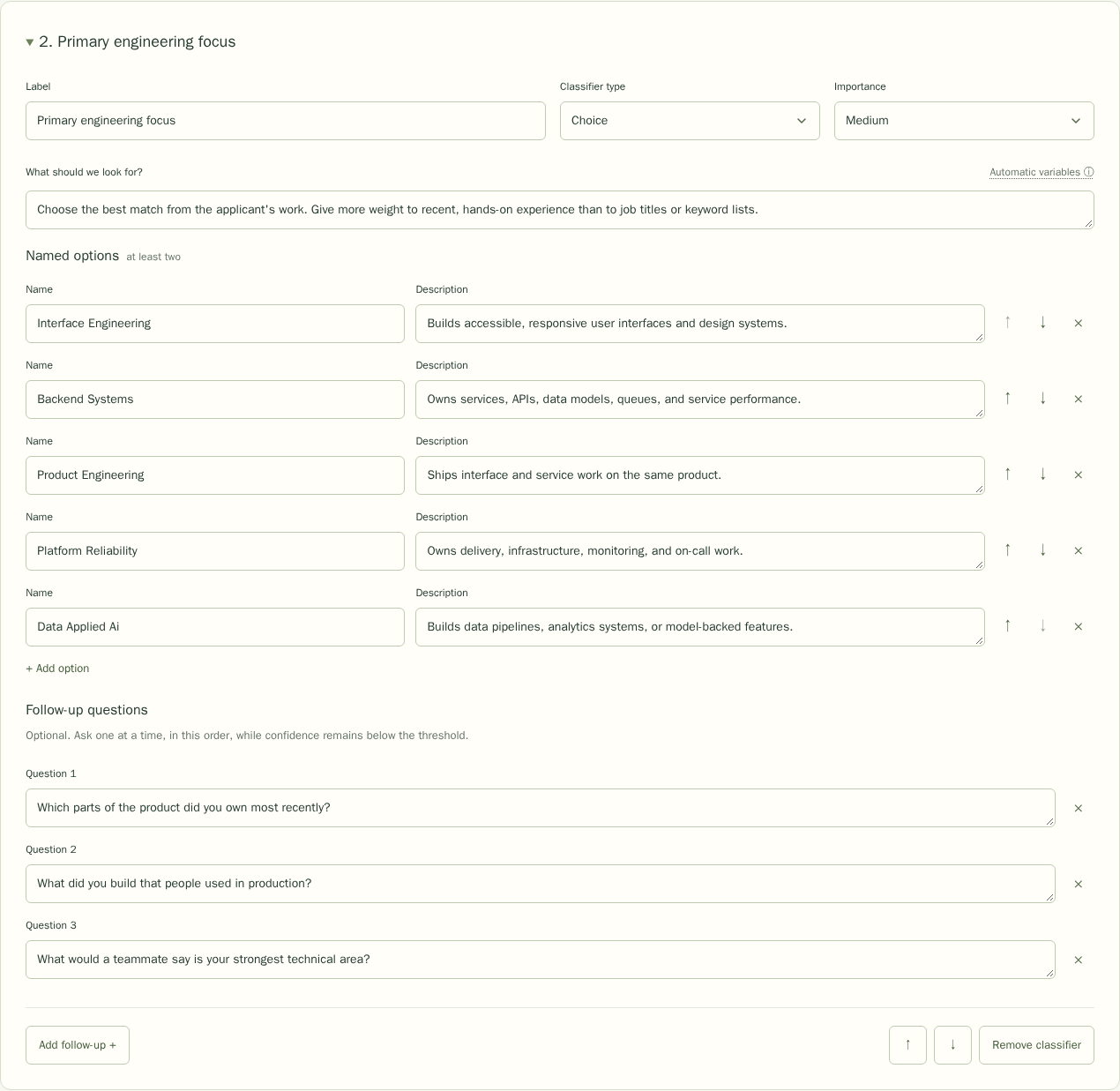
Use Choice when the possible outcomes are different categories, with no natural order. For a software role, a primary engineering focus classifier could use "Interface engineering", "Backend systems", "Product engineering", "Platform reliability", and "Data applied AI". Describe what each category means so that a reviewer can choose from the work shown, not from a title or a skills list.
Give every option a name and a short description. Options should be distinct enough that a reviewer can tell why one fits better than another. Add at least two options.
Yes / no
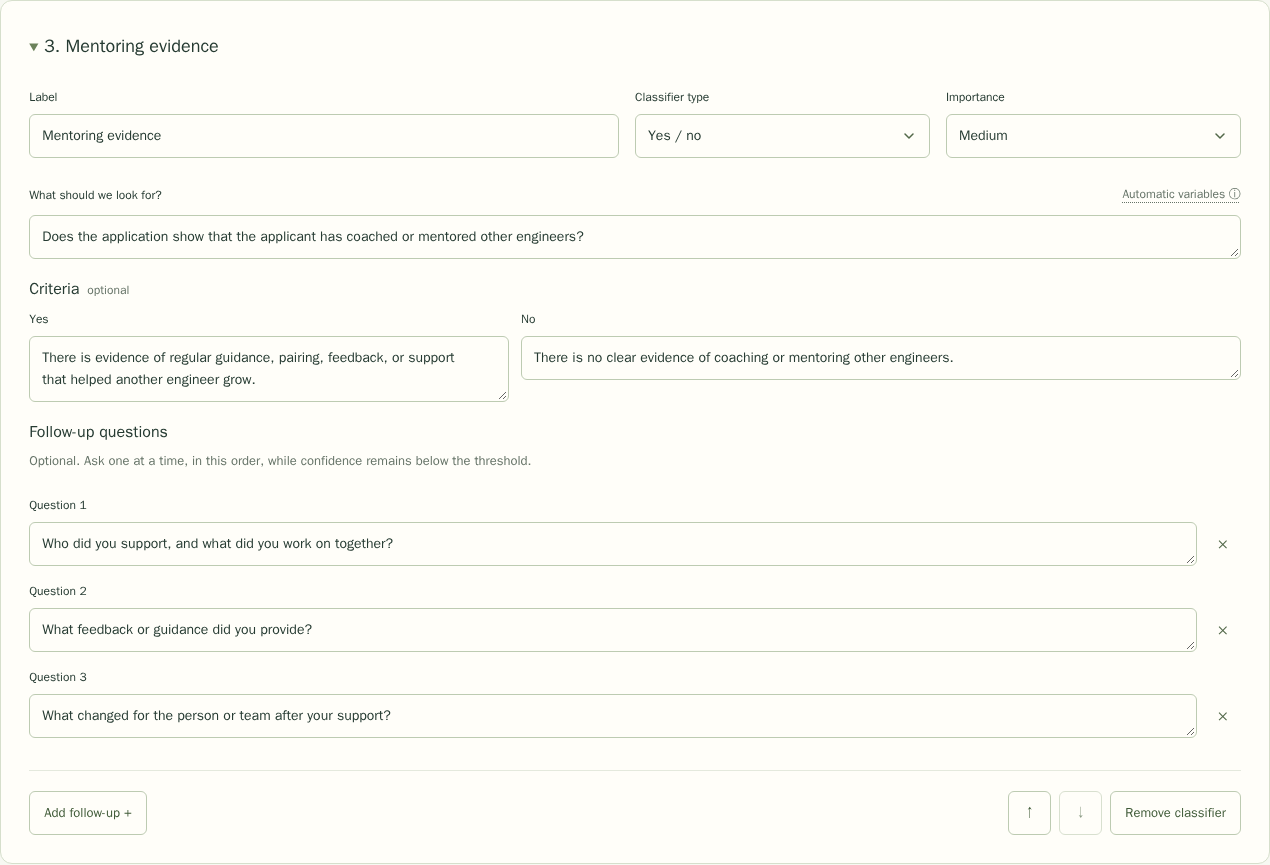
Use Yes / no for a direct question with two possible outcomes. For example, ask, "Does the application show that the applicant has coached or mentored other engineers?" Define Yes as evidence of regular guidance, pairing, or feedback that helped others grow. Define No as no clear evidence of that work.
The Yes and No descriptions are optional, but useful when the answer needs a specific definition. Write the classifier question in plain language and keep it focused on evidence in the application.
Follow-up questions and importance
Follow-up questions are optional, but they are useful for classifiers that matter to the hiring decision. The right questions help you spot the strongest applicants. Add at least three focused follow-ups for each of those classifiers. Acqoria asks them one at a time, in the order you set, when the application needs more context. Ask for a specific example, responsibility, or outcome. Avoid questions that repeat the job listing or require applicants to guess what answer you want.
Importance controls how much certainty is needed before a follow-up is useful. Use High for evidence you need to understand well, Medium for most role signals, and Low where a brief answer is enough. It is a reliability setting, not a hiring decision.
Last updated on